

Products
Monitoring and Managing Visa Flexible Credential Adoption
February 6, 2026
February 6, 2026

Grace Greenwood
Grace Greenwood
Grace Greenwood
In their latest earnings results, Visa highlighted their Flexible Credential solution, calling it the "Swiss Army knife of payments." It's a fair description, as this credential allows multiple funding sources from a single card, breaking the traditional setup of one card, one account, one funding source. Now customers can choose at checkout whether to fund a transaction with a debit account, credit line, or even a Buy Now Pay Later (BNPL) option.
This flexibility opens up new use cases, but it also creates new considerations for merchants around routing, authorization, and customer experience. To help merchants track these impacts, the Pagos BIN Database supports identification of VFC-enabled cards. Given Visa's renewed focus on this product, it's time to revisit how you can leverage this identifier in your payments data analysis.
Tracking Flexible Credential Cards
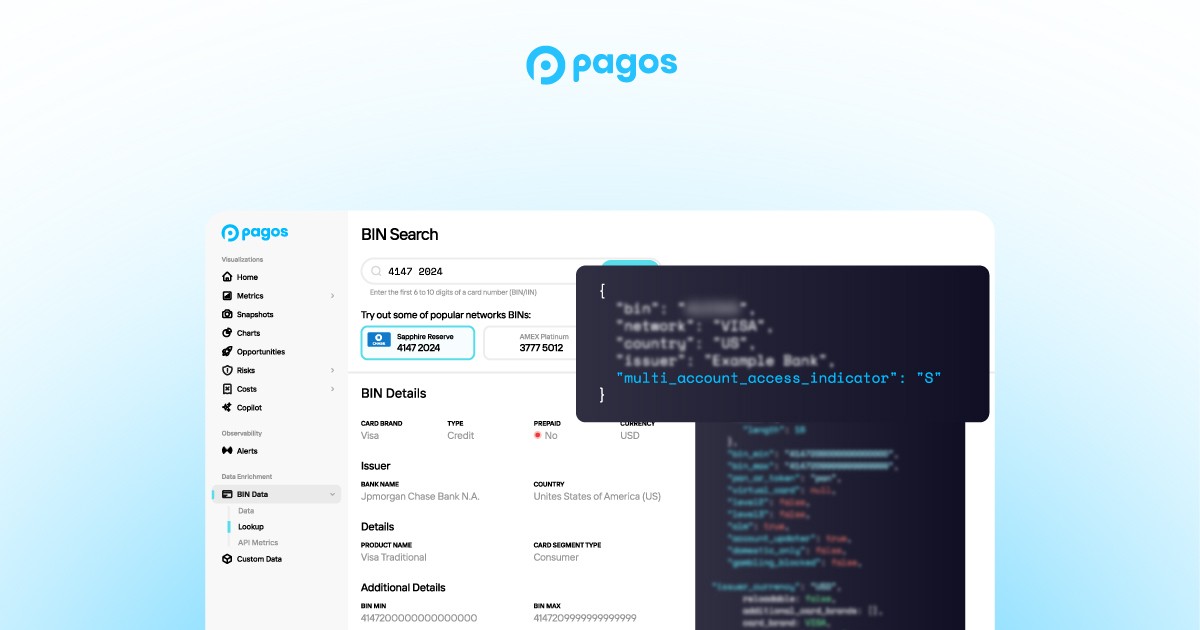
The Pagos BIN services include a specific field designed to identify Visa Flexible Credentials: the multi_account_access_indicator. This field appears in every BIN response and tells you exactly what type of multi-account functionality a card supports. The response in this field will always be one of the following options:
M (Multi-account managed): The issuer controls which account is used and when. The cardholder doesn't choose at checkout—the bank's rules determine the funding source.
S (Multi-account self-serve): The cardholder is in control. They can select which linked account they want to use for each transaction.
N (Not participating): This card doesn't support multi-account functionality. It's a standard, single-source credential.
Why This Matters for Your Business
Visa requires issuers to use dedicated BIN ranges for Flexible Credential cards, meaning you can rely on Pagos’ BIN data to track these cards for the following purposes:
1. Tracking adoption in real-time
Visa first launched Flexible Credentials in Japan; they’ve since expanded regional support slowly across APAC, Europe, CEMEA, and North America, with Affirm issuing VFC-enabled cards in the US. As it increases in popularity, you can monitor whether transaction volume is shifting to these new card products. Are your customers starting to use Flexible Credentials more frequently? Where? What funding source do they gravitate towards? Does it depend on the product type or purchase amount?
2. Optimizing your checkout experience
When you know a card supports Flexible Credential functionality, you can tailor your messaging accordingly. For multi-account self-serve cards, you might want to adjust your checkout flow or provide additional context about payment options. For issuer-managed cards, you can anticipate that the authorization might behave differently than a traditional card transaction.
3. Understanding authorization behavior
Multi-account cards may have different approval patterns depending on which underlying account is being charged. Having this intelligence up front helps you understand why certain transactions might be declined or why authorization rates vary across different BIN ranges or issuing banks.
Ready to Start Tracking Flexible Credentials?
If you're already using the Pagos BIN Database, the multi_account_access_indicator field is available in your API responses today. If you're not yet leveraging our BIN services, we recommend adding it to your payments-optimization toolkit for more reasons than just monitoring VFC cards. For more information, check out our guide on Unlocking the Power of BIN Data.
Want to learn more about how Pagos BIN Database can help you stay ahead of emerging card products? Get in touch with our team.
In their latest earnings results, Visa highlighted their Flexible Credential solution, calling it the "Swiss Army knife of payments." It's a fair description, as this credential allows multiple funding sources from a single card, breaking the traditional setup of one card, one account, one funding source. Now customers can choose at checkout whether to fund a transaction with a debit account, credit line, or even a Buy Now Pay Later (BNPL) option.
This flexibility opens up new use cases, but it also creates new considerations for merchants around routing, authorization, and customer experience. To help merchants track these impacts, the Pagos BIN Database supports identification of VFC-enabled cards. Given Visa's renewed focus on this product, it's time to revisit how you can leverage this identifier in your payments data analysis.
Tracking Flexible Credential Cards
The Pagos BIN services include a specific field designed to identify Visa Flexible Credentials: the multi_account_access_indicator. This field appears in every BIN response and tells you exactly what type of multi-account functionality a card supports. The response in this field will always be one of the following options:
M (Multi-account managed): The issuer controls which account is used and when. The cardholder doesn't choose at checkout—the bank's rules determine the funding source.
S (Multi-account self-serve): The cardholder is in control. They can select which linked account they want to use for each transaction.
N (Not participating): This card doesn't support multi-account functionality. It's a standard, single-source credential.
Why This Matters for Your Business
Visa requires issuers to use dedicated BIN ranges for Flexible Credential cards, meaning you can rely on Pagos’ BIN data to track these cards for the following purposes:
1. Tracking adoption in real-time
Visa first launched Flexible Credentials in Japan; they’ve since expanded regional support slowly across APAC, Europe, CEMEA, and North America, with Affirm issuing VFC-enabled cards in the US. As it increases in popularity, you can monitor whether transaction volume is shifting to these new card products. Are your customers starting to use Flexible Credentials more frequently? Where? What funding source do they gravitate towards? Does it depend on the product type or purchase amount?
2. Optimizing your checkout experience
When you know a card supports Flexible Credential functionality, you can tailor your messaging accordingly. For multi-account self-serve cards, you might want to adjust your checkout flow or provide additional context about payment options. For issuer-managed cards, you can anticipate that the authorization might behave differently than a traditional card transaction.
3. Understanding authorization behavior
Multi-account cards may have different approval patterns depending on which underlying account is being charged. Having this intelligence up front helps you understand why certain transactions might be declined or why authorization rates vary across different BIN ranges or issuing banks.
Ready to Start Tracking Flexible Credentials?
If you're already using the Pagos BIN Database, the multi_account_access_indicator field is available in your API responses today. If you're not yet leveraging our BIN services, we recommend adding it to your payments-optimization toolkit for more reasons than just monitoring VFC cards. For more information, check out our guide on Unlocking the Power of BIN Data.
Want to learn more about how Pagos BIN Database can help you stay ahead of emerging card products? Get in touch with our team.
In their latest earnings results, Visa highlighted their Flexible Credential solution, calling it the "Swiss Army knife of payments." It's a fair description, as this credential allows multiple funding sources from a single card, breaking the traditional setup of one card, one account, one funding source. Now customers can choose at checkout whether to fund a transaction with a debit account, credit line, or even a Buy Now Pay Later (BNPL) option.
This flexibility opens up new use cases, but it also creates new considerations for merchants around routing, authorization, and customer experience. To help merchants track these impacts, the Pagos BIN Database supports identification of VFC-enabled cards. Given Visa's renewed focus on this product, it's time to revisit how you can leverage this identifier in your payments data analysis.
Tracking Flexible Credential Cards
The Pagos BIN services include a specific field designed to identify Visa Flexible Credentials: the multi_account_access_indicator. This field appears in every BIN response and tells you exactly what type of multi-account functionality a card supports. The response in this field will always be one of the following options:
M (Multi-account managed): The issuer controls which account is used and when. The cardholder doesn't choose at checkout—the bank's rules determine the funding source.
S (Multi-account self-serve): The cardholder is in control. They can select which linked account they want to use for each transaction.
N (Not participating): This card doesn't support multi-account functionality. It's a standard, single-source credential.
Why This Matters for Your Business
Visa requires issuers to use dedicated BIN ranges for Flexible Credential cards, meaning you can rely on Pagos’ BIN data to track these cards for the following purposes:
1. Tracking adoption in real-time
Visa first launched Flexible Credentials in Japan; they’ve since expanded regional support slowly across APAC, Europe, CEMEA, and North America, with Affirm issuing VFC-enabled cards in the US. As it increases in popularity, you can monitor whether transaction volume is shifting to these new card products. Are your customers starting to use Flexible Credentials more frequently? Where? What funding source do they gravitate towards? Does it depend on the product type or purchase amount?
2. Optimizing your checkout experience
When you know a card supports Flexible Credential functionality, you can tailor your messaging accordingly. For multi-account self-serve cards, you might want to adjust your checkout flow or provide additional context about payment options. For issuer-managed cards, you can anticipate that the authorization might behave differently than a traditional card transaction.
3. Understanding authorization behavior
Multi-account cards may have different approval patterns depending on which underlying account is being charged. Having this intelligence up front helps you understand why certain transactions might be declined or why authorization rates vary across different BIN ranges or issuing banks.
Ready to Start Tracking Flexible Credentials?
If you're already using the Pagos BIN Database, the multi_account_access_indicator field is available in your API responses today. If you're not yet leveraging our BIN services, we recommend adding it to your payments-optimization toolkit for more reasons than just monitoring VFC cards. For more information, check out our guide on Unlocking the Power of BIN Data.
Want to learn more about how Pagos BIN Database can help you stay ahead of emerging card products? Get in touch with our team.
Share this Blog Post
Share this Blog Post
Let's Chat on

Want to dig deeper into payments data, news, and insights? Have hot takes of your own?
We're talking all things payments on Reddit.
Latest Blog Posts
Monitoring and Managing Visa Flexible Credential Adoption
Monitoring and Managing Visa Flexible Credential Adoption
Monitoring and Managing Visa Flexible Credential Adoption
Reduce the Cost of Payments Acceptance in 2026
Reduce the Cost of Payments Acceptance in 2026
Reduce the Cost of Payments Acceptance in 2026
Subscribe to our Blog
Subscribe to
our Blog
Subscribe to our Blog
By submitting, you are providing your consent for future communication in accordance with the Pagos Privacy Policy.
Let's Chat on
Let's Chat on
Want to dig deeper into payments data, news, and insights? Have hot takes of your own?
We're talking all things payments on Reddit.